Media vs Modi: Is Freedom of Speech at Risk in India Today?
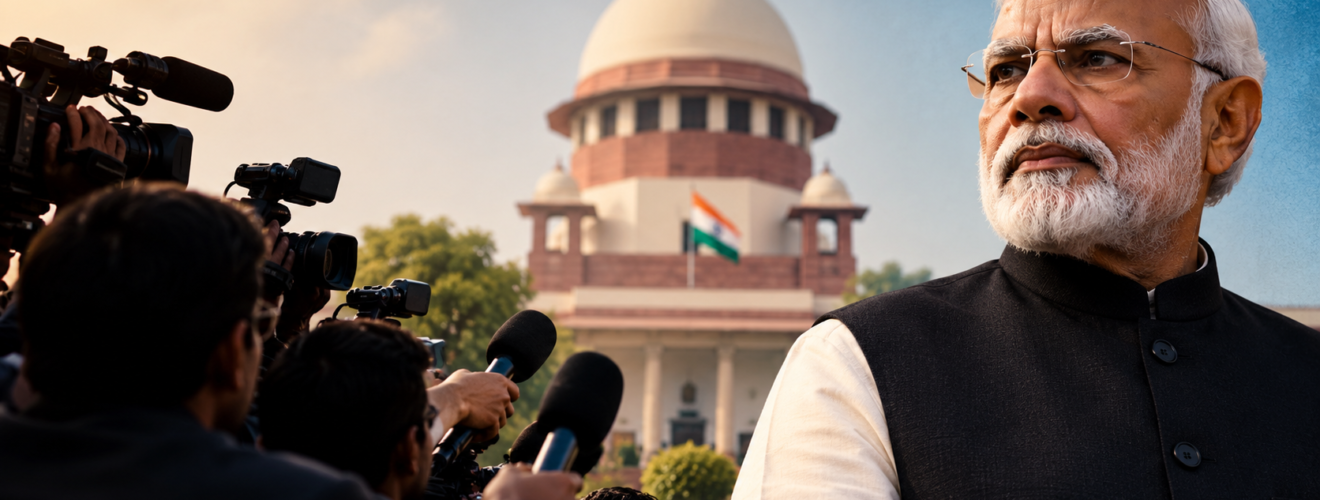
Freedom of speech is a key part of a democracy. It allows people to share their views, question their leaders and speak about problems without fear. The media has a special role in this process. Newspapers, television channels and digital news sites help people learn about public issues and hold those in power to account.
In India, the debate over press freedom has gained fresh attention under Prime Minister Narendra Modi. Critics say that journalists face legal pressure, threats and limits on their work, especially when they report on the government or other powerful groups. The government, however, rejects claims that it seeks to silence the media. It says that laws are needed to protect privacy, public order and national security.
As of October 28, 2026, three recent developments have brought this debate back into focus. Twenty-one news publishers have challenged parts of India’s data protection law in the Supreme Court. A press freedom group has reported that at least 43 journalists faced temporary detention during protests in October. India has also fallen to 157th place out of 180 countries in the 2026 World Press Freedom Index by Reporters Without Borders (RSF).
These facts have led to a wider question: can the media do its job freely while the government protects its own lawful interests?
What Does Freedom of the Press Mean?
Freedom of the press means that journalists and news organisations can report facts, ask hard questions and publish views without unfair pressure from the state or other powerful groups. It also means that people can access different views and make their own choices based on facts.
In India, Article 19(1)(a) of the Constitution gives citizens the right to freedom of speech and expression. This right forms the legal base for press freedom, even though the Constitution does not list a separate right called freedom of the press.
However, this right is not unlimited. Article 19(2) allows reasonable limits on speech for specific reasons, such as state security, public order and defamation. The main legal issue is whether a particular limit is lawful and fair.
The problem arises when a rule meant for a valid purpose also makes it hard for journalists to report on matters of public interest. A law may have a clear aim, yet its effect on free speech still needs careful review.
The DPDP Act Puts Media Freedom at the Centre of a Legal Fight
One of the biggest recent developments is the legal challenge to the Digital Personal Data Protection (DPDP) Act, 2023, and its rules. On October 27, 2026, the Digital News Publishers Association (DNPA), which represents the digital arms of 21 major news organisations, asked the Supreme Court to strike down several parts of the law.
The group includes major media names such as The Indian Express, The Hindu, India Today, the Times Group, Zee, NDTV and Network18. Some of these outlets belong to business groups linked to Mukesh Ambani and Gautam Adani.
The publishers argue that the law does not provide a clear exemption for journalistic work. They fear that rules on notice, consent and the removal of personal data could make it harder to report on public officials, alleged corruption and other matters of public concern.
For example, a journalist may need to examine the actions of a public official before that person knows about the report. If the reporter must first seek consent from the person under investigation, the report may become difficult or even impossible to publish.
The publishers also fear that rules on data access could expose confidential sources, such as people who share proof of wrongdoing with the press. They argue that these risks could harm investigative journalism and make some newsrooms less willing to publish sensitive reports.
The Supreme Court has issued notice to the Centre and has listed the case for November 17, 2026. The Court has also stressed the need to balance the right to privacy with the media’s right to report. The challenged provisions are due to take effect in May 2027 under the phased rollout of the law.
It is important to note that the Court has not yet ruled that these provisions are unconstitutional. The case remains open, and its final result may shape the future of digital journalism in India.
The Government’s Response to the Media’s Concerns
The government does not accept the claim that the DPDP Act harms press freedom. Union Information and Broadcasting Minister Ashwini Vaishnaw said on October 28, 2026, that the law does not undermine the constitutional freedom of the press.
He argued that the right to privacy is also a fundamental right and that the law aims to protect personal data rather than restrict news reports. He also noted that newspapers and television channels took part in the consultation process before the law came into force.
This is an important part of the debate. Personal data can be misused, and ordinary citizens also need protection from the unwanted use of their private details. A news report does not give a journalist an automatic right to publish every personal detail about another person.
The challenge is to create clear rules that protect both privacy and public interest. The Supreme Court must assess whether the law strikes a fair balance or places an undue burden on legitimate news work.
Forty-Three Journalists Faced Detention During October Protests
A second major concern arose during protests in New Delhi and other cities on October 10 and 11, 2026. The protests called for action over the role of Chief Election Commissioner Gyanesh Kumar and alleged errors in the revision of voter lists.
The Committee to Protect Journalists (CPJ) reported that at least 43 journalists faced temporary detention while they covered these events. The group said that some reporters were also assaulted, heckled or stopped from doing their work.
According to CPJ, at least 39 journalists were detained in New Delhi, while four others faced detention at related protests in other cities. Some reporters said that police seized phones or pressured journalists to delete footage. CPJ also reported that some journalists were struck by police.
Human Rights Watch raised similar concerns about police conduct and the treatment of journalists at the protests. It called for an end to arbitrary detention and for the protection of peaceful protest and media freedom.
Delhi Police, for its part, cited public order concerns and issued rules for journalists at the protests. A senior police officer told The Hindu that some reporters may have been detained because they were too close to protesters during police action.
These different accounts matter. A temporary detention does not by itself prove that the government has a policy to silence journalists. At the same time, press cards and professional duties should not leave reporters open to unlawful detention or violence. The facts of each case, the conduct of the police and any later legal action all deserve close review.
India’s Press Freedom Rank Falls to 157th Place
The 2026 World Press Freedom Index by Reporters Without Borders places India at 157th out of 180 countries. In 2025, India held the 151st place. Its score also fell from 32.96 in 2025 to 31.96 in 2026.
The index looks at several parts of the media environment, such as political pressure, legal rules, economic conditions, social factors and the safety of journalists. India’s 2026 position shows a lower rank than the previous year.
This result is a warning sign, but it needs context. The index is not a count of all press freedom cases in India, nor does it prove that every journalist faces the same risks. It is an assessment by an independent press freedom group based on its own method.
Other groups, such as Freedom House and Human Rights Watch, have also raised concerns about threats, self-censorship, legal cases and limits on online speech. Yet private media outlets in India continue to publish critical reports and question public officials. The media landscape is not the same across all states, outlets or types of news.
The key issue is whether journalists have enough freedom and safety to report facts, even when those facts may upset people in power.
Modi’s Relationship With the Media
Narendra Modi’s approach to the press has also drawn attention. Critics often point to his limited use of open, unscripted press conferences as a sign of weak direct access for journalists.
In May 2026, during a visit to Oslo, Norwegian journalist Helle Lyng called out to Modi and asked why he did not take questions from the press. He left without a response. The event drew fresh attention to the way the prime minister deals with media questions.
A leader’s choice to avoid a press conference is not, by itself, proof of a legal violation. However, regular access to open questions gives reporters a chance to seek answers on public policy, official decisions and claims made by the government.
Critics also raise concerns about media ownership. Large business groups own or hold interests in major news outlets, and some observers fear that close links between business and political power may weaken editorial freedom.
Still, it would be wrong to assume that every outlet follows the same line or that every report reflects pressure from the state. A fair assessment must look at actual cases, the evidence available and the response of each news organisation.
Why Independent Journalism Matters
Independent journalism helps people understand how public money is spent, how laws affect daily life and whether public officials meet their duties. It can expose fraud, poor public services, abuse of power and errors in official claims.
When journalists fear threats, legal action or police pressure, they may avoid certain subjects. This is known as self-censorship. It can occur even without a formal ban because reporters and editors may fear the cost of a report that upsets powerful people.
Such limits can harm the public as well as the media. Citizens need reliable facts to judge public policy and take part in a democracy. A free press also helps the state by exposing mistakes before they become larger problems.
At the same time, journalists must act with care. False claims, unfair harm to private people and the misuse of personal data are real concerns. Press freedom should go hand in hand with fact checks, fair reporting and accountability.
What Happens Next?
The next major step is the Supreme Court hearing on November 17, 2026, in the case over the DPDP Act. The Court’s view on privacy, public interest and the need for a clear journalistic exemption may set an important legal standard.
The phased rollout of the law is due to continue, with the challenged provisions set for May 2027. The final rules and any court orders will matter to newsrooms that deal with private data or confidential sources.
There is also a need for clear answers on the October protests. Reports of journalist detention, assault and obstruction deserve proper review. Where officials have acted unlawfully, there should be a fair process to establish responsibility.
Future press freedom reports will offer another way to assess change. India held 157th place out of 180 countries in 2026, down from 151st in 2025. The next results may show whether the situation has improved or worsened, but the reasons behind any change will matter as much as the rank itself.
Conclusion
The debate over media freedom under Modi is not a simple story of one side being right and the other wrong. There are real concerns about the legal risks faced by journalists, the treatment of reporters at protests, online restrictions and the level of access that leaders offer to the press. Recent reports and the fall in India’s press freedom rank give these concerns weight.
The government, meanwhile, says that privacy, security and public order are valid aims, and that the Constitution protects freedom of speech. These claims also deserve review through facts, law and open debate.
The main test is whether India’s laws and public institutions allow journalists to report on matters of public interest without unfair pressure. The Supreme Court’s review of the DPDP Act will be an important part of that test.
A strong democracy needs both privacy and a free press. It needs laws that protect citizens but do not make it hard for reporters to expose wrongdoing. Above all, people need access to facts, open debate and fair legal review so that they can judge the record of those who hold power.
Also Read – Careers Society Should Never Accept as Normal