Hyundai vs Nissan: Which Brand to Consider in 2026
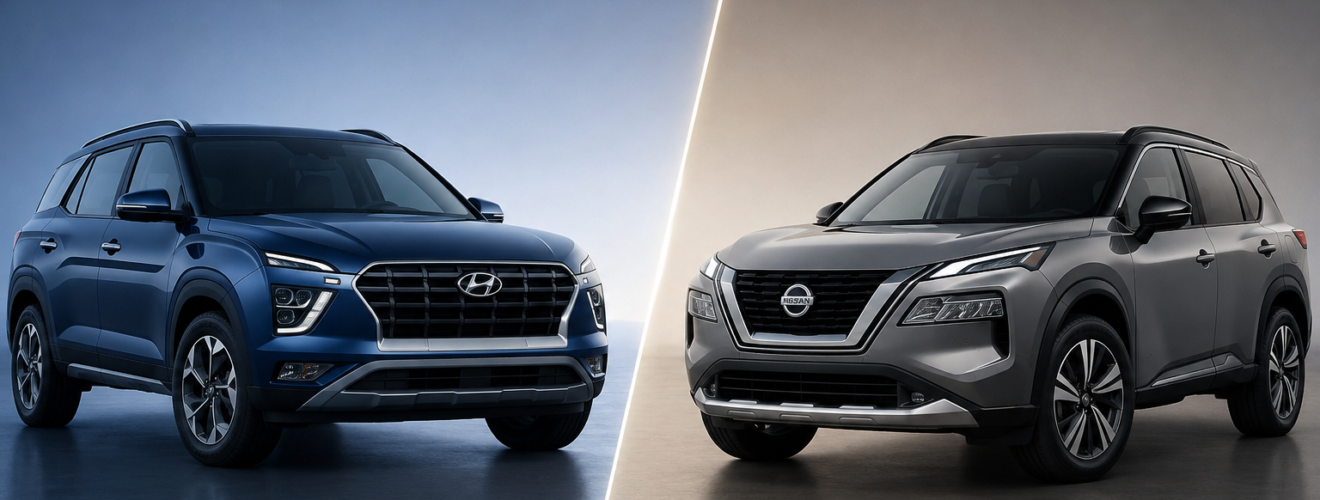
Hyundai and Nissan are two well-known car brands, but their position in India is very different in 2026. Hyundai has a large product range, strong sales, a wide dealer network and a clear EV plan. Nissan, on the other hand, is on a comeback path with new models such as the Gravite and Tekton.
So, which brand should buyers consider in 2026?
The simple answer is Hyundai for most buyers. It offers a safer overall choice due to its size, model range, sales strength and EV options. Yet Nissan is now far more interesting than it was a few years ago. Its new products have helped the brand post a sharp rise in sales.
The latest numbers make this comparison even more useful. Hyundai sold 54,210 cars in India in July 2026, up 23.3 percent from the same month last year. Nissan sold 4,518 units, up 218 percent year on year.
Hyundai Has a Huge Sales Lead
Hyundai has a clear lead in terms of sales volume. In July 2026, Hyundai Motor India sold 54,210 units in the domestic market. Its total sales, which also include exports, stood at 75,360 units. That was a 25.4 percent rise from July 2025.
The company sold 21,150 units for export in July, up 31.4 percent year on year. Hyundai said this was its highest monthly total sales figure since its start in India. Its export figure was also its highest in more than 100 months.
The Creta was a major part of this result. It sold 18,088 units in July, its best monthly result of 2026. The i20 also had a strong month with 6,738 units.
These figures show the depth of Hyundai’s customer base. The company does not depend on just one car. It has several models that can bring buyers into its showrooms.
Nissan is still much smaller. Its July 2026 domestic sales stood at 4,518 units. Yet the growth rate deserves attention. Sales were up 218 percent from July 2025 and about 50 percent from June 2026.
The gap remains very large, but Nissan’s growth shows that its new product plan has started to make a real difference.
Nissan’s Comeback Is Worth a Closer Look
Nissan’s story is one of the most interesting parts of the 2026 car market.
For a long time, the Magnite was the main model that kept the brand visible in India. That has now changed. Nissan has added the Gravite and Tekton to its range, which gives it a much wider presence.
The Tekton had a strong first full month in July. It sold 1,670 units and became Nissan’s top model for the month. The Magnite sold 1,462 units. The new models together made up 3,056 units, or almost 68 percent of Nissan’s July sales.
The Tekton also has a clear price advantage. Nissan lists the model from ₹10.49 lakh in India.
The Gravite starts at ₹5.73 lakh. This gives Nissan a strong value message at the lower end of the market.
However, buyers should not treat one strong month as proof of a full turnaround. Nissan needs to keep this pace for a longer period. A six to twelve month view will give a clearer picture of its real market position.
Hyundai Offers More Choice
Hyundai’s biggest strength is its broad model range.
A buyer can look at the Exter, Grand i10 Nios, i20, Venue, Creta, Alcazar, Verna, Tucson, Creta Electric and IONIQ 5. This gives the brand a place in several price and body style groups.
That matters because buyers do not always want the same type of car. Some want a small city car. Others want a compact SUV, a family SUV, a sedan or an EV.
Hyundai can serve most of these needs through its own range.
Nissan has fewer choices. Its main India range now has the Magnite, Gravite and Tekton. This is a much smaller set of cars.
Still, a smaller range is not always a bad thing. Nissan can focus more attention on these models and use sharper prices to attract buyers. The early sales data for Gravite and Tekton suggests that this plan has merit.
For buyers who want maximum choice, Hyundai has the clear edge. For buyers who want a simpler shortlist, Nissan may still make sense.
Hyundai Has the EV Advantage
Electric cars are another major area where Hyundai has a clear lead.
Hyundai already has the Creta Electric and IONIQ 5 in India. The Creta Electric gives the brand a much stronger presence in the mainstream EV market, while the IONIQ 5 sits at a much higher price point.
Hyundai has also used a new approach to reduce some of the concerns around EV ownership. The Creta Electric now has a 60 percent assured buyback after three years or 45,000 km, subject to the scheme terms.
Hyundai has also offered a Battery-as-a-Service plan. Under this model, the upfront price of the Creta Electric can fall to ₹10.99 lakh, with a battery subscription cost of ₹3.9 per km.
This can make an EV easier for some buyers to consider.
Nissan has a long history with electric cars in global markets, but its current India range does not offer a similar mainstream EV choice.
This gives Hyundai a strong advantage for buyers who want to move to electric power in 2026.
Financial Strength Matters Too
A car brand needs more than good products. It also needs enough financial strength to support new cars, service networks, technology and future investment.
Hyundai entered 2026 from a much stronger financial base.
For 2025, Hyundai Motor reported revenue of KRW 186.3 trillion. Its operating profit stood at KRW 11.47 trillion, with an operating margin of 6.2 percent. Net profit was KRW 10.36 trillion. Global vehicle sales were about 4.14 million units.
These results were not perfect. Operating profit fell 19.5 percent from the prior year, while net profit fell 21.7 percent. Hyundai also faced tariff pressure and tougher global competition.
Even so, the company remained profitable at a very large scale.
Nissan’s financial position is more difficult.
For fiscal year 2025, Nissan reported global sales of 3.15 million units and revenue of ¥12.0 trillion. Its net loss was ¥533.1 billion. Operating profit was only ¥58.01 billion.
There is some good news for Nissan. Its first quarter of fiscal 2026 produced an operating profit of ¥77.9 billion and a net profit of ¥3.8 billion. Yet the company cut its full-year sales forecast from 3.3 million to 3.15 million units due to a tougher market, especially in China.
So the financial picture is quite simple. Hyundai has a strong and stable base. Nissan is still on a recovery path.
Hyundai Also Has Its Share of Problems
Hyundai is not a perfect choice.
The company has faced higher costs and pressure on profits. Its global business also faces tariff risks, weak demand in some markets and stronger competition from Chinese car brands.
In India, Hyundai has also announced a price rise of up to 1 percent from September 2026. That could make some models slightly less attractive on price.
The company also faced labour issues in South Korea, with a full strike in August 2026. Such events can affect production and add pressure to costs.
These issues do not erase Hyundai’s advantages, but they show why buyers should not judge a brand only by its sales figures.
Nissan Brings Better Value Potential
Nissan’s biggest appeal in 2026 may be value.
The Gravite starts at ₹5.73 lakh, while the Tekton starts at ₹10.49 lakh. These prices give Nissan a strong base for buyers who want an SUV without a very high starting cost.
The new models also give Nissan a chance to rebuild its image in India.
The July sales numbers are a good sign. The company moved 4,518 domestic units, with Tekton at 1,670 units and Magnite at 1,462 units.
If this pace stays strong, Nissan could become a much more serious rival in the Indian market.
But there is still a question over long-term scale. Hyundai has years of evidence behind its position. Nissan has only recently started this new phase.
Which Brand Is Better in 2026?
For most buyers, Hyundai remains the better overall brand to consider in 2026.
Its sales are much higher. Its model range is wider. Its EV choice is stronger. Its global financial position is healthier. It also has a large base of popular models such as Creta, Venue and i20.
The numbers tell the same story. Hyundai sold 54,210 domestic units in July 2026, while Nissan sold 4,518. That means Hyundai’s domestic July sales were about 12 times Nissan’s volume.
Nissan, however, deserves more attention than before. Its 218 percent annual sales rise is too large to ignore. The Gravite and Tekton have added fresh energy to the brand, while the Magnite still gives it a known and affordable option.
This makes Nissan a good choice for buyers who value price and want to try a newer product from a brand on the rise.
Final Verdict
Hyundai is the safer choice for 2026. It has the scale, product range, EV options, sales strength and financial base that most buyers want from a car brand.
Nissan is the more interesting alternative. Its new models have made the brand much more relevant, and its sales growth shows that buyers are responding.
The best way to sum it up is simple: Hyundai is the stronger brand today, while Nissan has the more exciting comeback story.
For a buyer who wants low risk and plenty of choice, Hyundai should be the first brand to consider. For someone who wants a newer SUV at a sharp price and is comfortable with a brand that is still rebuilding its position, Nissan deserves a serious look.
The final choice, however, should come down to the exact cars. A Nissan Tekton can be a better buy than a Hyundai Creta for one buyer, while the Creta may be the better fit for another. Brand strength matters, but the right car, price, engine, features and ownership needs matter even more.
Also Read – MINI Cooper S Convertible Review 2026: Fun Open-Top Car