
How Governments Needed Farmers Then Targeted Their Land
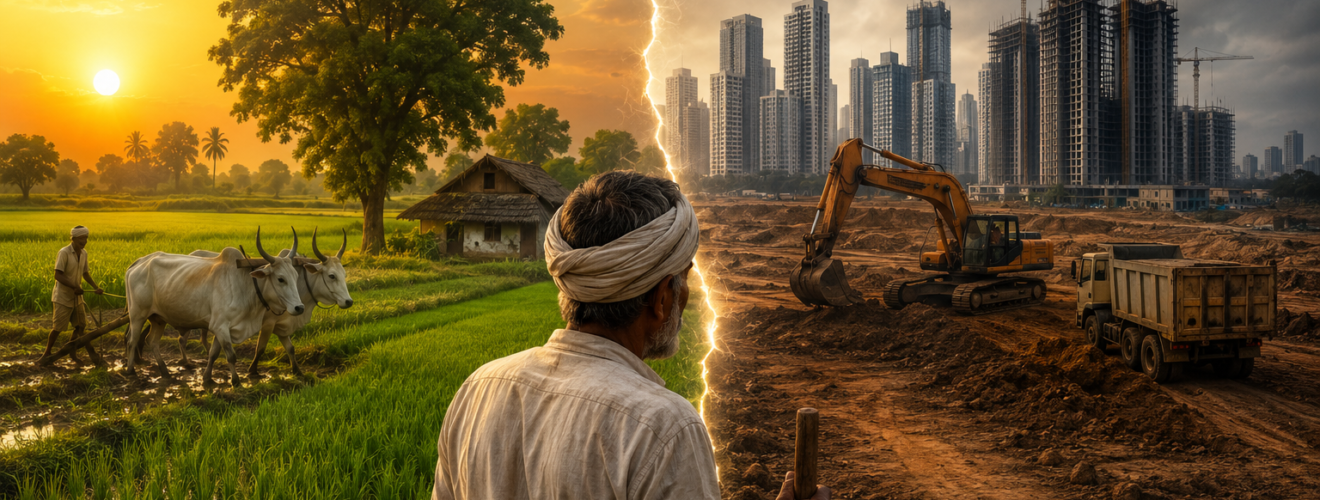
After India became independent in 1947, the country faced a very serious problem. There was not enough food for millions of people. Large parts of India suffered from food shortage, weak farming systems, and poor agricultural output. At that time, the government had only one major goal. It wanted the country to produce enough food so people could survive.
India depended heavily on agriculture, but farmers had very little support. Most farmers worked on land that they did not even own. Big landlords controlled huge areas of farmland, while poor farmers spent years working for them without security. The government knew that if agriculture failed, the entire country would face hunger.
Because of this, farmers became extremely important for the nation. The government started policies that openly encouraged people to stay in agriculture and increase food production. The message was simple. The country needed farmers, and farmers would help build the future of India.
At this stage, agriculture was not just an economic activity. It was a matter of national survival.
The Government Started Changing Land Ownership Rules
During the 1950s, the government introduced major land reforms. Before independence, large feudal systems controlled farming land. A system called Zamindari allowed landlords to own huge pieces of land while farmers worked under them.
The government wanted to break this structure. New laws removed many old landlord systems. Farmers slowly started receiving rights over the land they worked on. Land ceiling laws also came into force. These laws fixed a limit on how much land one individual could own.
The government believed that if farmers became landowners, they would work harder and increase production. More crops meant more food security for the country.
At that time, the state openly supported the farmer community because India depended almost entirely on agriculture.
The government needed farming to succeed.
Public Money Started Flowing Into Agriculture
Once land reforms began, the government started huge investment programs for agriculture. Farmers received direct support in many forms.
Large dam projects came up across the country. Canal systems expanded so farms could receive water regularly. Rural cooperative banks started giving easier credit to farmers. Fertilizer prices stayed low because the government paid subsidies. New seed programs helped improve crop quality.
Agricultural universities also started opening in different states. Scientists worked on crop research so farmers could get better harvests.
For many years, the government spent enormous public money just to strengthen farming.
The reason was very clear.
If farmers stopped producing food, India would face national crisis.
The state actively pushed agriculture because the nation had no choice.
The Green Revolution Changed Everything
By the 1960s, India still struggled with food shortage. Population growth created even more pressure. The government then launched one of the biggest agricultural efforts in Indian history.
This became known as the Green Revolution.
Scientist M. S. Swaminathan played a major role in this transformation. The government introduced new high-yield wheat and rice seeds. Farmers received chemical fertilizers at subsidized rates. Pesticides became common. Tube well irrigation expanded quickly.
The government also introduced a strong procurement system through the Food Corporation of India, known as FCI. Farmers received Minimum Support Price, often called MSP. This system guaranteed that the government would buy crops at fixed prices.
For farmers, this reduced risk. For the government, this ensured food security.
The message again remained very direct.
Grow more food. The country depends on you.
This period showed perhaps the strongest partnership between government and farmers.
Farmers Helped India Become Self-Sufficient
The Green Revolution produced huge results.
States such as Punjab, Haryana, and western Uttar Pradesh became major food producers. Wheat and rice output increased sharply. India slowly stopped depending on foreign countries for food imports.
This was a major success story for the government.
For decades, farmers played the central role in making India food secure. Public policy revolved around helping agriculture grow faster.
The nation celebrated farmers because they helped solve one of the biggest national problems.
Without farmers, India could not have reached food self-sufficiency.
For many years, the state treated agriculture as the backbone of the country.
Economic Liberalization Started Changing Priorities
The year 1991 brought major economic change.
India opened its economy to private business and global markets. The government shifted focus toward industrial growth, foreign investment, private sector expansion, and international trade.
Slowly, agriculture stopped receiving the same level of policy attention.
The country now focused more on factories, services, finance, infrastructure, and urban development.
This change did not happen overnight, but priorities clearly shifted.
Earlier governments focused heavily on farmers because food production stood at the center of national planning.
After economic liberalization, agriculture slowly moved lower in policy importance.
The economy started looking beyond farming.
This period marked the first visible change in how governments viewed land itself.
Farmland Started Becoming More Valuable Than Farming
As cities expanded rapidly, a new economic reality emerged.
Land itself became extremely valuable.
Areas near cities that once existed only for farming started attracting real estate developers, factories, industrial zones, highways, warehouses, airports, and private townships.
Earlier, land existed mainly as a farming resource.
Now, land became an economic asset.
The value of one acre near an expanding city often rose far beyond the value of crops grown on that same land.
This created a serious conflict.
Farmers wanted to continue agriculture.
Governments increasingly wanted land for development projects.
For the first time, productive farmland and economic development started competing against each other.
Governments Started Acquiring Large Areas of Agricultural Land
After the 2000s, land acquisition became much more common.
State governments across India started acquiring farmland for major infrastructure projects. New expressways required huge land stretches. Industrial corridors needed thousands of acres. Special Economic Zones, also known as SEZs, expanded rapidly after 2005.
Private companies also sought land for factories, logistics hubs, and commercial projects.
Large urban development plans demanded more space.
In many cases, fertile agricultural land became the first target because it often existed near roads and expanding cities.
Farmers in several states started raising concerns.
They believed governments now viewed farmland more as property than as a source of food production.
This created tension between rural communities and state authorities.
Farmers Started Asking Difficult Questions
Many farmer groups started noticing a pattern.
For decades, governments requested farmers to increase production. Subsidies, irrigation, MSP systems, and public support programs all existed because the country needed agriculture.
But once agriculture became stable and land values increased, governments started taking interest in the same land for non-farming purposes.
This led many farmers to ask an uncomfortable question.
If agriculture was once so important for national survival, why was fertile land now under constant pressure from infrastructure and private development projects?
Farmer organizations argued that the very land protected for decades suddenly became attractive for entirely different reasons.
The land now held financial value far beyond crop production.
This changed the relationship between farmers and the state.
Public Backlash Forced New Land Protection Laws
As disputes increased, public anger also grew.
Several controversial land acquisition cases across India triggered protests. Farmers argued that governments often paid compensation below future land value. Many families lost agricultural income permanently after land transfer.
This pressure forced legal reform.
In 2013, India introduced the Right to Fair Compensation and Transparency in Land Acquisition Act.
This law created stronger legal safeguards.
Governments now needed social impact assessments before major acquisition projects. Compensation rules became stronger. Rehabilitation and resettlement obligations became part of the law.
Consent from affected communities became an important factor in certain situations.
This law existed mainly because farmers strongly opposed aggressive land acquisition practices.
It reflected growing distrust between rural communities and policymakers.
The 2020 Farm Laws Created Massive Fear
In 2020, the government introduced three major farm laws.
Officials said these reforms would modernize agriculture. Farmers would gain freedom to sell crops outside traditional government markets. Private investment would enter the agricultural sector. Middlemen would lose control.
But many farmer unions strongly disagreed.
They believed large corporations would eventually dominate pricing. Farmers feared that MSP protections might weaken over time. Contract farming arrangements created concern about dependency on powerful private buyers.
Huge protests started across India.
Thousands of farmers camped for months, especially near Delhi. The protests became one of the largest political movements in recent Indian history.
Many farmers believed these laws represented another shift away from direct farmer protection.
Eventually, after massive protests, the government withdrew the laws in 2021.
But distrust remained.
New Land Disputes Continue Across India
Recent years have seen fresh disputes over agricultural land.
In Karnataka, controversy emerged around the Bidadi Township project. Farmers objected to acquisition of fertile land for development plans.
Punjab also saw conflict around land pooling schemes. Critics argued that large agricultural areas could permanently leave food production systems.
Maharashtra witnessed protests where farmers opposed land acquisition connected to industrial projects.
These cases show that the conflict has not disappeared.
The same issue continues to appear in different states.
Governments seek land for development.
Farmers seek protection for agricultural livelihood.
The debate continues.
Why Many Farmers Feel Betrayed
Many farmer organizations now express a deep sense of betrayal.
Their argument follows a simple timeline.
For decades, the government needed food security. Farmers received support because the country depended on agriculture.
Farmers worked hard and helped make India self-sufficient.
Over time, land values increased because cities expanded and economic growth accelerated.
Now governments often prioritize highways, industrial parks, real estate projects, airports, logistics hubs, and urban expansion.
Farmer groups feel that the same agricultural land once protected for national development now faces pressure because it has become financially valuable.
From their perspective, the relationship changed dramatically.
Earlier governments needed farmers.
Now governments need their land.
The Bigger Economic Reality Behind This Conflict
There is another side to this issue.
Modern economies require infrastructure. Roads, industries, airports, and logistics networks help economic growth. Governments argue that development projects create jobs and improve national progress.
But agriculture also remains essential.
Food security still depends on productive farmland.
When fertile land disappears permanently under construction projects, agricultural output can eventually suffer.
This creates a difficult balance.
How much land should remain protected for farming?
How much land should governments use for development?
This question has no easy answer.
Economic growth and food production now compete for the same physical space.
A Historical Shift That Changed Everything
When India struggled with hunger after independence, governments desperately needed farmers.
They introduced land reforms, irrigation projects, subsidies, scientific research, credit support, MSP systems, and procurement programs.
Farmers helped transform India from a food-deficient country into a food-secure nation.
But economic reforms after 1991 slowly shifted national priorities.
Industry, infrastructure, private investment, and urban growth became central policy goals.
Farmland began carrying value beyond agriculture itself.
As this happened, conflicts over land acquisition increased.
Today, many farmers believe governments no longer view agriculture the same way they once did.
What once represented national survival now often represents economic opportunity.
This historical shift explains why land disputes have become one of the biggest political and social tensions in modern India.
The story began with governments asking farmers to feed the nation.
Today, many farmers believe governments look at that same land for entirely different reasons.
And that debate continues to shape the future of India.
Also Read – AI IPO Buzz Grows as Big Tech Firms Plan Market Debut